Most pet owners change their filter more often. That's a good instinct — but it's only half the answer.
After working with thousands of pet households, we've learned something that doesn't show up in standard HVAC advice: dander and fine pet hair don't just clog filters faster — they coat evaporator coils, restrict airflow at return vents, and accumulate in duct bends where standard maintenance never reaches. Changing filters on schedule helps. But without addressing those other pressure points, your system still labors, your air quality still suffers, and your energy bills still climb.
That's exactly why the 12x26x4 air filter matters here. Its deeper media bed captures what a 1-inch filter lets pass — giving your system a fighting chance between service visits.
What follows are the maintenance habits we actually recommend to pet-owning homeowners — not generic checklists, but the specific steps that move the needle on system performance and indoor air quality when pets are part of the picture.
TL;DR Quick Answers
12x26x4 Air Filters
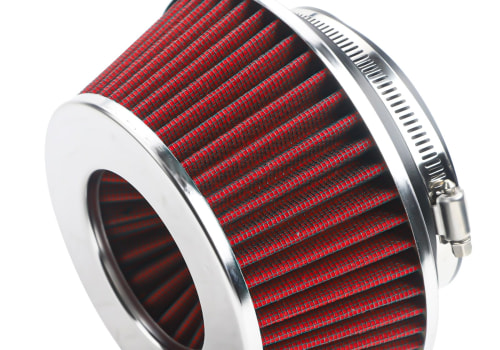
A 12x26x4 air filter is a deep-media HVAC filter measuring 12 inches wide, 26 inches tall, and 4 inches deep — designed for whole-home filtration in residential forced-air systems.
What makes it different:
4-inch depth provides up to 4x the media surface area of a standard 1-inch filter
Higher dust-holding capacity means longer service intervals
Available in MERV 8, MERV 11, and MERV 13 ratings for different filtration needs
Who it's best for:
Pet households with elevated particulate load
Allergy and asthma sufferers requiring finer particle capture
Homeowners seeking fewer filter changes without sacrificing air quality
Recommended change intervals:
Standard household: every 6–12 months
One pet: every 60–90 days
Multiple pets: every 45–60 days
Bottom line: The 12x26x4 filter is the right specification for any home where a standard 1-inch filter loads too quickly, restricts airflow too soon, or fails to capture fine dander and airborne allergens effectively.
Top Takeaways
Filter depth is the variable most pet owners miss. A 12x26x4 filter holds significantly more load before airflow restriction occurs — it's the single most impactful upgrade a pet household can make.
Changing filters more often is only half the answer. Coil buildup, vent obstruction, and duct leakage compound the problem in ways a filter schedule alone can't fix.
MERV rating determines what actually gets captured. Start at MERV 11 for single-pet homes. Step up to MERV 13 for multiple pets or allergy sufferers. Never exceed what your system can support.
Pet allergens are in virtually every U.S. home — even without pets. Effective HVAC filtration is a health priority, not just a comfort preference.
Filter overload and duct leakage stack against you simultaneously. Address both together — filter capacity and duct integrity — or the fix won't hold.
Why Pet Households Put Unique Demands on Your HVAC System
Standard maintenance advice wasn't written with pets in mind — and that gap is where most pet owners run into trouble.
Pets introduce a specific combination of airborne stressors your system cycles continuously:
Pet dander — microscopic skin flakes that stay airborne for hours
Pet hair — accumulates at return vents and accelerates filter loading
Tracked-in debris — dirt, pollen, and biologicals carried in on paws and fur
Pet odor compounds — VOCs that recirculate through sealed, conditioned air
The result is a system working harder, filtering less effectively, and degrading faster than your neighbor's identical unit — simply because pets live there.
Why Filter Depth Matters More Than Change Frequency
Most pet owners focus on changing filters more often. That helps. But filter depth is the variable that changes the equation entirely.
A 12x26x4 filter's deeper media bed holds significantly more contaminant before airflow restriction occurs — which matters enormously when particulate load runs consistently higher than average.
Up to four times the media surface area of a standard 1-inch filter
Higher dust-holding capacity means longer service intervals without sacrificing efficiency
More interception points for fine dander, hair fibers, and airborne allergens
In our experience, pet owners who switch from 1-inch to 4-inch filters report a noticeable difference in both air quality and how quickly their system bounces back between service visits.
The Right MERV Rating for Your Pet Household
Filter thickness handles volume. MERV rating determines what gets captured.
MERV 8 — captures larger hair and debris; suitable for very light pet households
MERV 11 — captures finer dander particles; our recommended starting point for most pet owners
MERV 13 — captures the finest allergens; best for multi-pet homes or allergy sufferers
One important note: never size up to a MERV rating your system can't support. A filter that's too restrictive for your blower creates its own set of problems. When in doubt, MERV 11 is the right balance for the majority of pet households.
The Maintenance Steps Most Pet Owners Overlook
Filter changes are the foundation. These are the steps that actually separate a well-maintained pet household system from one quietly losing ground.
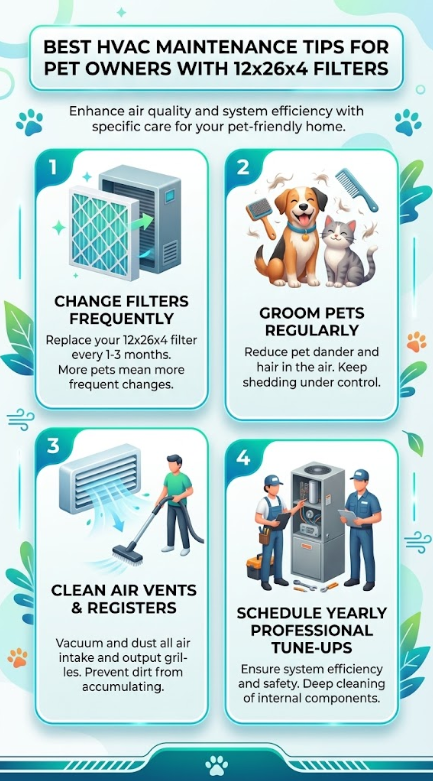
Adjust your change interval. With one pet, plan for every 60–90 days. Multiple pets: every 45–60 days. Check at 30 days initially to calibrate your specific home's load rate.
Clean return vents monthly. Pet hair mats at grilles and restricts airflow even when the filter isn't fully loaded. Vacuum grilles monthly and wipe the inner duct collar quarterly.
Inspect the evaporator coil annually. Dander that bypasses an overloaded filter coats the coil — reducing efficiency, raising energy costs, and creating conditions for mold. This is the maintenance step most homeowners never hear about, and the one that costs the most when ignored.
Address duct leaks. Leaky ducts in a pet household pull unfiltered air directly into your supply stream. No filter can compensate for bypass at the source.
Warning Signs Your System Is Losing the Battle With Pet Debris
Watch for these signals between service visits:
Filter loading faster than your established interval
Reduced airflow from supply registers despite a recently changed filter
Persistent pet odor when the system runs — not just at startup
Visible hair or dust accumulation on supply vent grilles
Unexplained energy bill increases without a change in usage
One sign warrants attention. Two or more together warrant a professional inspection before the problem compounds into a repair.

"In our experience, the pet owners who struggle most with HVAC performance aren't skipping filter changes — they're using the wrong filter depth for the load their system is actually carrying; switching to a 4-inch media filter with the right MERV rating is consistently the single adjustment that makes everything else work the way it should."
Essential Resources
Choosing the right 12x26x4 air filter is only part of the equation. Understanding the science behind filtration, pet allergens, and HVAC performance gives you the full picture — and helps you make decisions that actually protect your home and family. These are the resources we point pet-owning homeowners to most often.
1. How to Choose the Right HVAC Filter for Your Home
The EPA's consumer guide cuts through the confusion around filter types, MERV ratings, and what different filters actually capture — and don't. If you're trying to decide between filtration options for a pet household, this is the foundational resource we recommend starting with. U.S. Environmental Protection Agency https://www.epa.gov/indoor-air-quality-iaq/guide-air-cleaners-home
2. Understanding MERV Ratings: The Industry Standard Explained
MERV ratings aren't marketing — they're a standardized testing methodology developed by ASHRAE, the engineering body that sets the rules for how filters are evaluated. This resource explains exactly what those numbers mean and how to match filter efficiency to your system's real-world needs. American Society of Heating, Refrigerating and Air-Conditioning Engineers (ASHRAE) https://www.ashrae.org/technical-resources/filtration-and-disinfection-faq
3. The Science Behind Pet Allergens in Your Home
Most pet owners assume allergens settle out of the air quickly. They don't. NIEHS research shows pet dander, saliva proteins, and skin cells remain airborne and circulate through HVAC systems continuously — which is exactly why filter depth and MERV rating matter so much in pet households. National Institute of Environmental Health Sciences (NIEHS) https://www.niehs.nih.gov/health/topics/agents/allergens/pets
4. Pet Dander, Asthma, and Indoor Air Quality
The CDC's guidance on asthma triggers specifically calls out pet fur, dander, and skin proteins as primary household allergens — and recommends upgraded HVAC filtration as a front-line control strategy. Useful reference for any pet household, especially those with allergy or asthma sufferers. Centers for Disease Control and Prevention (CDC) https://www.cdc.gov/asthma/control/index.html
5. How Your Air Filter Directly Affects Energy Costs
A clogged filter doesn't just hurt your air quality — it forces your HVAC system to work harder, which drives up energy bills and accelerates equipment wear. ENERGY STAR's guidance on filter maintenance intervals is something we share with homeowners regularly because the connection between filter condition and utility costs is one of the most underappreciated variables in home comfort management. ENERGY STAR / U.S. Environmental Protection Agency https://www.energystar.gov/saveathome/heating-cooling
6. Why Duct Leaks Undermine Everything Else You're Doing
Upgrading to a deeper, higher-MERV air filter is one of the best moves a pet owner can make — but leaky ducts can pull unfiltered air directly into your supply stream, bypassing the filter entirely. The DOE's duct sealing resource explains where leaks occur, what they cost you, and why sealing is a critical complement to any filter upgrade. U.S. Department of Energy https://www.energy.gov/energysaver/minimizing-energy-losses-ducts
7. Filter Installation: Why Fit and Placement Matter as Much as the Filter Itself
In our experience, a correctly specified filter installed incorrectly performs like a lower-rated filter. The DOE's Building Science Education Center explains how filter placement, sealing, and sizing interact — and what goes wrong when any one of those variables is off. U.S. Department of Energy — Building Science Education Center https://bsesc.energy.gov/energy-basics/hvac-proper-installation-filters
Supporting Statistics
Your Home's Air Is More Concentrated Than You Think
Indoor air pollutant concentrations are often 2 to 5 times higher than typical outdoor concentrations — and Americans spend approximately 90% of their time indoors.
What that means in a pet household:
Your home doesn't just recirculate air — it recirculates a continuously replenished supply of dander, hair fibers, and biological debris
Every HVAC cycle repeats that exposure
Filters in pet homes load significantly faster than in pet-free homes — we see this consistently
A deeper media bed isn't an upgrade. It's a direct response to what this data describes.
Source: U.S. Environmental Protection Agency — Indoor Air Quality
URL: https://www.epa.gov/report-environment/indoor-air-quality
Pet Allergens Are in Almost Every U.S. Home — Including Yours
NIEHS research found that dog and cat allergens are present in virtually all U.S. homes — including homes without pets — and more than 50% of U.S. households have a dog, cat, or both.
What most homeowners miss:
Pet allergens are buoyant, microscopic, and persistent — they don't settle, they stay airborne
They transfer on clothing, travel through shared building HVAC systems, and linger on surfaces for months
The pet owners who struggle most with air quality aren't ignoring their filters — they're using a filter never rated to intercept particles this fine
MERV rating isn't a technical detail. For pet households, it's the whole game.
Source: National Institute of Environmental Health Sciences (NIEHS) — Pet Allergens
URL: https://www.niehs.nih.gov/health/topics/agents/allergens/pets
Filter Condition and Duct Leakage Are Costing You More Than You Realize
ENERGY STAR reports that nearly half of all home energy use goes to heating and cooling — and poorly sealed duct systems alone can account for up to 30% efficiency loss.
What compounds the problem in pet homes:
An overloaded filter increases static pressure across the system
Higher static pressure forces the blower to work harder against restricted airflow
That drives up energy consumption independent of duct condition
When filter overload and duct leakage occur together, efficiency loss stacks — fast
This is one of the most consistent patterns we observe when evaluating underperforming systems in pet households
The fix isn't one or the other — filter capacity and duct integrity have to be addressed together
Source: ENERGY STAR / U.S. Environmental Protection Agency — Clean Heating and Cooling
URL: https://www.energystar.gov/products/energy_star_home_upgrade/clean_heating_cooling
Final Thoughts
Most HVAC maintenance advice treats every home the same. In our experience, that's where pet owners consistently get shortchanged.
What follows isn't theory. It comes from years of working inside pet households — inspecting overworked systems, undersized filters, and ductwork quietly undoing every maintenance step the homeowner is doing right.
What we've learned that standard advice doesn't cover:
Filter depth matters more than changing frequency. A 1-inch filter changed every 30 days will never outperform a properly rated 4-inch filter on a sensible interval. Media surface area and dust-holding capacity are what move the needle in high-load environments — and a pet household is always a high-load environment.
The evaporator coil is the most overlooked surface in a pet home. We've inspected coils coated in years of accumulated dander — buildup no filter change could have prevented because the filter was already overloaded. That buildup doesn't just reduce efficiency. It creates conditions for mold growth that circulates through every room.
Most struggling pet owners are doing everything right. Changing filters. Vacuuming regularly. Grooming pets consistently. Still dealing with elevated energy bills, reduced airflow, and persistent odor. In almost every case, the missing variable isn't effort — it's filter specification and duct integrity not working together as a system.
The 12x26x4 filter is the engineering response to this exact problem.
Deeper media bed handles continuous high-particulate load
Higher dust-holding capacity extends service intervals without sacrificing efficiency
Greater surface area intercepts fine dander before it reaches the coil
Our honest opinion:
The right filter paired with the right maintenance routine isn't just a comfort upgrade for pet owners. It's the difference between a system that keeps pace with what pets introduce into your air — and one that slowly, invisibly, and expensively loses ground to it.
You love your pets. Protecting your air quality is one of the most practical ways to protect your home, your system, and everyone who shares that space with them.
FAQ on 12x26x4 Air Filters
Q: What does the 12x26x4 size mean, and how do I know if it's the right filter for my system?
A: The three numbers are width, height, and depth.
The 4-inch depth is the critical measurement — it determines how much load the filter holds before airflow restriction occurs
A 12x26x4 filter's actual dimensions are typically 11.75 x 25.75 x 3.75 inches — nominal and actual sizes differ
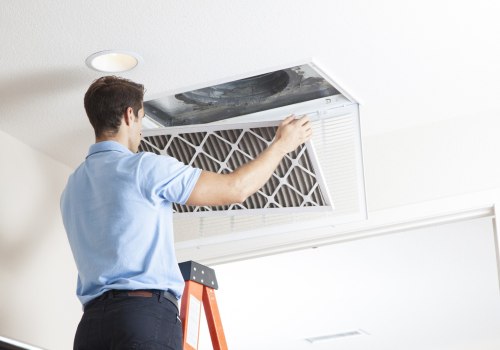
Always measure the slot opening in your return air grille or air handler — not the old filter
A correct fit seals the frame cleanly with no gaps
Any gap around the edges means unfiltered air is bypassing the media entirely
The most common sizing mistake we see: measuring the old filter instead of the slot.
Q: How often should I change a 12x26x4 air filter in a home with pets?
A: Standard guidance is 6 to 12 months. In a pet household, that interval needs to be shortened.
Recommended change intervals by household type:
One pet: inspect at 30 days, replace every 60–90 days
Multiple pets: inspect at 30 days, replace every 45–60 days
Multiple pets plus allergy or asthma sufferers: inspect monthly, replace based on what you see
The step most pet owners skip: the 30-day inspection.
What the filter looks like at 30 days tells you more than any printed guideline
Pet type, shedding volume, home size, and daily runtime all affect load rate differently
Let the filter tell you the interval — not the packaging
Q: What MERV rating should I choose for a 12x26x4 filter in a pet household?
A: MERV rating determines whether your filter intercepts the particles that matter most — fine dander, skin proteins, and airborne allergens.
MERV recommendations by household type:
MERV 8 — larger hair and debris only; suitable for very light pet exposure
MERV 11 — finer dander particles; recommended starting point for most single-pet households
MERV 13 — finest airborne allergens; best for multi-pet homes or allergy and asthma sufferers
Critical caution:
Never select a MERV rating your blower can't support
Too high a rating creates excessive static pressure
Excessive static pressure restricts airflow, reduces efficiency, and accelerates equipment wear
When in doubt, start at MERV 11 — it consistently delivers the right balance for most pet households
Q: Is a 12x26x4 filter actually better than a standard 1-inch filter for pet owners, or is it just more expensive?
A: It's not about price. It's about media volume under real-world load conditions.
A 4-inch filter vs. a 1-inch filter:
Up to 4x the media surface area
More interception points for fine dander, hair fibers, and airborne allergens
Higher dust-holding capacity before airflow restriction occurs
Longer service intervals — often offsetting the higher per-unit cost
The pattern we see repeatedly in pet households running 1-inch filters:
Filter loads faster than expected
Airflow restricts sooner than it should
System works harder to compensate
Energy costs climb and equipment wear accelerates
Switching to a 4-inch format breaks that cycle. It's not a premium option — it's the right specification for the load a pet household consistently puts on a filter.
Q: Can a 12x26x4 air filter help reduce pet odors in my home?
A: Yes — but only with the right filter type. Here's the distinction that matters:
Standard MERV filter — captures particulate matter: dander, hair, skin cells; does not neutralize odors
Activated carbon filter — adsorbs volatile organic compounds (VOCs) responsible for actual odor
Combined MERV + activated carbon filter — addresses both particulate load and odor at the source
For meaningful odor reduction, you need all three elements working together:
A high-MERV media layer to capture biological debris
An activated carbon component to adsorb odor-causing VOCs
Consistent change intervals — a loaded filter stops capturing either effectively
What we've consistently observed:
Pet households using a 4-inch filter with activated carbon and a proper change schedule report a noticeable reduction in background odor
In homes where HVAC runs year-round, removing particulate load cycle after cycle compounds in the right direction over time
Results aren't instant — but they're real and measurable
Ready to Put These HVAC Maintenance Tips to Work for Your Pet Household?
Explore our full selection of 12x26x4 air filters — available in MERV 8, MERV 11, and MERV 13 — and find the right filter depth, rating, and change interval for the load your pets actually put on your system. Order today and experience the difference the right filter makes in your home's air quality, system performance, and energy costs.Learn more about HVAC Care from one of our HVAC solutions branches…
Filterbuy HVAC Solutions
2521 NE 4th Ave, Pompano Beach, FL 33064
(754) 484-4453